
The Strategic Advantage of Never Actually Doing Anything

I’ve noticed something about people who say their job is “strategy.” The more someone talks about setting strategy, the less actual work they seem to do. This isn’t a casual observation. This is a mathematical relationship. If you plotted it on a graph, you’d get a perfect inverse correlation: as strategic importance increases, tangible output approaches zero.
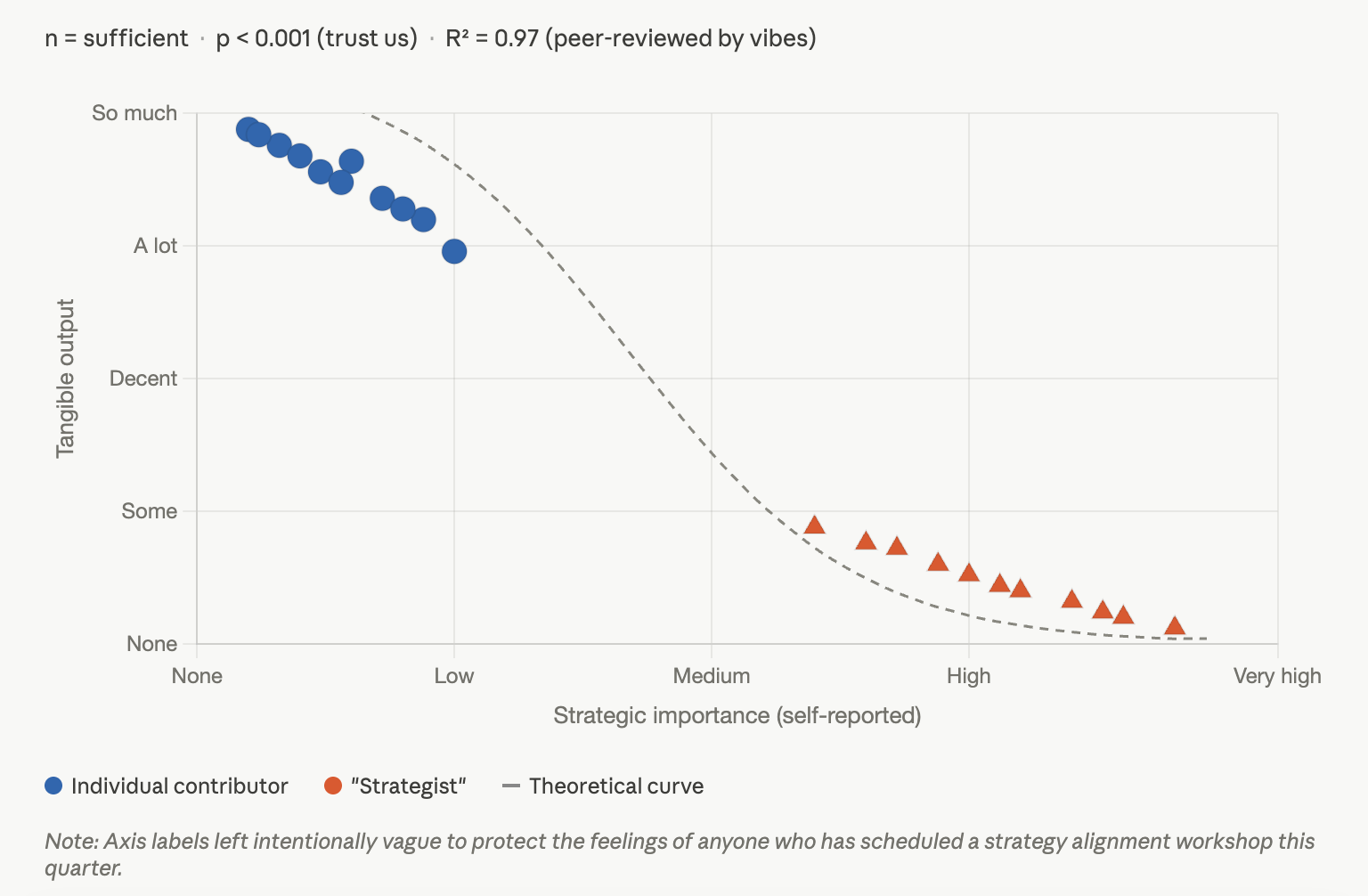
The first question I want to ask anyone who says “I’m a strategist” is: what does that mean? And the second question, which I’m borrowing from a 1999 workplace documentary, is: “what would you say you do here?”

These are reasonable questions. If someone tells you they’re a plumber, you know what they do. They fix pipes. If they’re an electrician, they fix wiring. If they’re a teacher, they teach. A surgeon operates. But strategy? Strategy is what happens when you’ve successfully convinced everyone that thinking about work is more valuable than doing work.
Here’s what “I do strategy” actually means: “I am going to tell other people what to do, even though I have never done it myself, and I have absolutely no intention of ever doing it.” It’s a job description that would make a feudal lord blush. At least the lord had to occasionally ride a horse into battle. The strategy person doesn’t even have to open Excel.
My favorite version is the freelance strategist. Like I am supposed to pay you to tell me what to do? All for the low price of $1,500 for the “strategy document”? That. Is. Hilarious.
Think about how we got here. At some point in corporate history—I’m guessing around the time we started calling employees “human capital”—someone realized you could rebrand “not doing the actual work” as “strategic thinking.” This was a genius move. Before this rebranding, if you didn’t do the work, you were just lazy. After the rebranding, you were too important to do the work. Your mind was occupied with higher-order concerns. You were seeing the forest while everyone else was stuck counting trees. But the irony here is that the person thinking about the forest, had never actually touched a tree or knew what trees were made of.
The beauty of strategy as a job function is that it’s completely unfalsifiable. If the strategy works, you’re a visionary. If it fails, well, the execution was flawed. You can’t blame the strategy. The strategy was perfect. The strategy existed in a pure realm of PowerPoint slides and whiteboard sessions, unsullied by the messy reality of implementation. It’s like being a football coach who only draws plays on a chalkboard and then blames the players when the plays don’t work, except the coach at least used to play football.
Let me walk you through what a strategy person actually does all day, taken from a time-motion study I did (ok, not really):
9:00 AM - Meeting about the meeting that will happen next week to discuss the strategic framework
10:30 AM - Coffee with a stakeholder to “align on vision”
11:00 AM - Work on a PowerPoint deck that explains why the strategy from last quarter needs to be revised
12:00 PM - Lunch meeting to discuss strategic priorities
1:30 PM - Review someone else’s work and provide “strategic feedback,” which means suggesting they think bigger without providing any specific guidance on what that means
3:00 PM - Another meeting about frameworks, methodologies, or roadmaps—anything that sounds important but doesn’t require doing anything
4:30 PM - Send an email about the importance of execution while not executing anything
You’ll notice that none of these activities produce anything you can hold, touch, or measure. This is by design. The moment you produce something concrete, someone can evaluate whether it’s good or bad. Strategy exists in the realm of the theoretical, the directional, the “let’s take this offline and circle back.”
The strategy person has convinced everyone that their job is to point at the horizon and say, “We should go that way.” Never mind that they don’t know how to build a boat, can’t read a map, and get seasick in the bathtub. They’re not boat-builders. They’re not navigators. They’re not sailors. They’re strategists. Their job is to have opinions about boats while other people build them, sail them, and bail water when they start sinking.
And here’s the thing that makes this whole system work: everyone is terrified to ask what strategy actually means because asking makes you sound like you don’t get it. It’s the emperor’s new clothes, except the emperor is wearing a lanyard and carrying a Moleskine notebook. If you ask “But what do you actually do?” you’re not strategic enough to understand. You’re too in the weeds. You’re not thinking at the right altitude.
The altitude metaphor is perfect, by the way. Strategy happens at 30,000 feet. Execution happens on the ground. The strategy person gets to fly over everything, pointing down at problems and saying “Someone should fix that,” while never landing the plane. They’ve literally positioned themselves above the work.
I think my favorite part of the strategy industrial complex is how it’s become self-perpetuating. Now we have Chief Strategy Officers who manage Vice Presidents of Strategy who oversee Directors of Strategic Initiatives who supervise Strategy Managers. It’s strategies all the way down. Somewhere at the bottom of this pyramid is one person actually doing something, and they’re probably an intern.
And consider how funny the specialization of strategy has become. For example, there are strategists within different job functions, i.e., “I do product strategy”, or “I do marketing strategy”, or “I do UX strategy”. All of these say one thing to me—“we specialize in doing nothing, but now within a specific discipline.”
The really impressive achievement is that strategy people have convinced everyone—including themselves—that what they do is not just legitimate but essential. More than essential: it’s the most important work in the organization. Never mind that the company existed before the strategy role was created. Never mind that the actual product gets built by engineers, sold by salespeople, and supported by customer service. The strategy person has successfully argued that none of that matters without someone pointing in a direction first, even if that direction changes every quarter.
We’ve built an entire corporate infrastructure around the idea that some people are too valuable to do actual work. We’ve created a class of professional direction-givers who have never done the thing they’re giving directions about. And we’ve all agreed to pretend this makes sense.
It’s another one of those systems that’s completely broken but nobody wants to admit it, because too many people have built careers on it. Saying strategy isn’t real work would be like telling a medieval peasant that maybe the divine right of kings is just something kings made up. Technically true, but you’re going to make a lot of people uncomfortable.
So the next time someone tells you their job is strategy, ask them what that means. Watch them try to explain it. Watch them use words like “direction” and “alignment” and “framework” and “strategic imperative.” Watch them describe a job that somehow requires their full attention while producing nothing you can see.
Then ask them what they would say they do here.
I’m still waiting for a good answer as I ponder why work doesn’t work.