
The Entrepreneur Coach Who Doesn't Believe in Entrepreneurs

Something weird happened last week, and I’m still chewing on it.
I wrote a LinkedIn post about how almost anyone can spin up a little weekend business and make a few bucks.
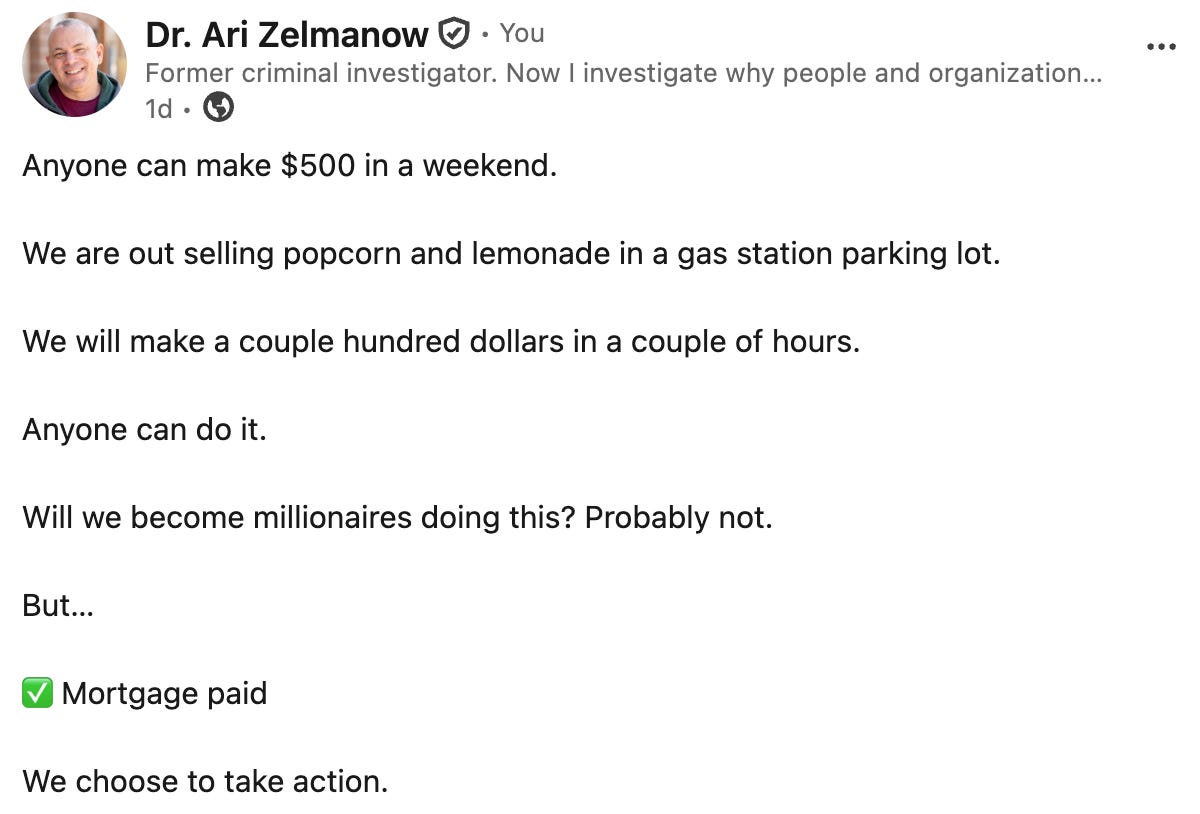
Simple idea. We choose to sell lemonade and popcorn. But anyone could sell baked goods, packaged seasonings, or a myriad of other options. Nothing revolutionary—just the observation that the barrier to earning money outside your day job is lower than most people think.
Then a troll hops in the comments and says, “I don’t think anybody can do that.”
Cool. Except this guy is an entrepreneur coach.
Read that again. The person who gets paid to convince people they CAN build something doesn’t believe they can. That’s like hiring a swim instructor who’s scared of water. Or a marriage counselor filing for divorce every six months. The entire value proposition collapses the moment you notice the contradiction.
So I pushed back a little. Nothing crazy. Just pointed out that maybe telling people they’re incapable isn’t the best sales pitch for someone in the belief-building business.
And what does he do? Posts one more gem about how “people can’t even come up with $100 to start a business,” then blocks me.
Brave.
Here’s what that block tells you: he wasn’t interested in a conversation. He was interested in protecting a worldview. And that worldview—the one he’s selling to clients who pay him actual money—is that most people are too broke, too dumb, or too broken to do anything about their situation. Maybe think twice before hiring this winner.
Which raises an uncomfortable question: if you don’t believe your clients can succeed, what exactly are you coaching them toward? Expensive resignation?
The Belief Problem Nobody Wants to Talk About
Henry Ford nailed this a hundred years ago: “Whether you think you can or you think you can’t, you’re right.”
That’s not a motivational poster. That’s a description of how human behavior actually works. Belief operates as a causal force. If you genuinely think something is impossible, you won’t try. And if you don’t try, you guarantee the outcome you predicted.
The entrepreneur coach proved Ford’s point backward. He’s built a career on the assumption that people can’t, and then—surprise—his clients probably don’t. Self-fulfilling prophecy dressed up as market analysis.
But here’s where it gets interesting. Most organizations know belief matters. They just pretend it doesn’t because acknowledging it would require them to admit they’ve been ignoring the foundation of the entire structure.
Thomas Gilbert figured this out in the 1970s with his Behavior Engineering Model. He identified six factors that actually drive performance:
Information. Do people know what’s expected?
Resources. Do they have the tools to do the job?
Incentives. Does doing the work make sense for them?
Knowledge. Do they have the skills?
Capacity. Can they physically or mentally handle it?
Motivation. Do they believe it’s possible and worth doing?
Most companies obsess over the first five. They’ll spend six figures on new software, hire consultants to rewrite job descriptions, restructure incentive plans, send people to training seminars, and conduct ergonomic assessments of office chairs.
But motivation? Belief? That’s soft stuff. Touchy-feely. Can’t measure it on a dashboard.
Except you can measure it. You measure it by watching what happens when someone doesn’t believe they can succeed. They don’t start. They don’t persist. They quit before the first obstacle. And then everyone stands around wondering why the training didn’t work, why the tools went unused, why the incentives didn’t move the needle.
The entrepreneur coach skipped straight to the end of that process. He looked at his clients and decided they couldn’t. And once you’ve made that decision, everything you do reinforces it. You become a gatekeeper instead of a guide.
The $100 Smokescreen
Let’s talk about that $100 comment, because it’s doing some heavy lifting.
On the surface, it sounds like economic realism. “People can’t even come up with $100 to start a business.” Sure, some people genuinely can’t. Poverty is real. Financial constraints are real.
But that’s not what he was saying.
He was using economic hardship as a universal excuse. A way to preemptively explain why nobody should bother trying. And that’s where the gatekeeping gets insidious, because it wraps itself in concern for the struggling.
Here’s the thing: I’d hand $100 to somebody who says “I need a hundred bucks to start a business and feed my family” before I’d give a dime to someone who’s been bitter about a layoff for three years and just wants rent covered.
One person has a plan. The other has a grievance.
One person sees the $100 as a tool. The other sees it as proof the system is rigged.
Give a man a fish, he eats tonight. Teach him to fish, he eats forever. The entrepreneur coach is standing on the dock explaining why fishing is impossible and the lake is empty and the rods are too expensive anyway.
The real barrier isn’t the $100. The real barrier is the voice in your head—or in the comments section—telling you that you’re not the kind of person who does things like this.
And when that voice belongs to someone you’re paying to help you succeed? That’s not coaching. That’s a protection racket.
What We Owe the Gatekeepers
Nothing.
We owe them nothing.
The entrepreneur coach isn’t protecting people from failure. He’s protecting himself from being wrong. Because if someone actually does spin up a weekend business and makes a few bucks, it exposes the lie he’s been selling: that success requires his permission, his framework, his expensive program.
Gatekeepers don’t just fail their clients. They reinforce the systems that keep people from trying. They turn possibility into a luxury good, available only to people who’ve already cleared some arbitrary bar of worthiness.
And when you challenge them? They block you.
Because the last thing a gatekeeper wants is someone standing next to the gate saying, “Hey, you know this thing isn’t locked, right?”
Ford was right. You can, or you can’t. Both are true.
But only one of those truths builds anything.
The other just builds a career out of other people’s doubt.
If you are ready to build your own Handshake Business, I can help you get there.
If you want me to help you do it, 1:1, click here: